It seems you can't swing a dead cat around these days without hitting a software application for advisors that is touting itself as having "integrated AI." They're boasting about hours saved, plans optimized, tax strategies analyzed — all thanks to Artificial Intelligence — the Gold Rush of our times. And the advisors, in turn, are happily relaying this information to their clients.
But while these software vendors are screaming "There's gold in them thar tools!", with each new update, I wonder if advisors really understand the underlying technology that is being marketed as AI. Are they paying for fool's gold while potentially exposing themselves to SEC fines?
Defining Artificial Intelligence
There is a lot of confusion these days swirling around the concept of AI. Everyone wants it, everybody seems to be using it, and now every software vendor is labeling itself as having it. Unfortunately, the term "AI" is being used to describe several different technologies and this is causing a lot of confusion among advisors. Because if an application you've been using for years suddenly starts calling itself "AI-enabled", you may erroneously think that all AI has the same capabilities and carries the same risks. But nothing could be further from the truth.
Let's break down some of the technologies that marketers are lumping into the "Artificial Intelligence" bucket, and then we'll talk about why the technology matters a lot less than what happens to the data it touches.
Examples of "Artificial Intelligence"
OCR (Optical Character Recognition)
People are now lumping OCR in with AI, which is funny because it's based on a technology that predates the internet. In fact, it was introduced in 1914 by Emanuel Goldberg to translate printed characters into Morse code for the telegraph. OCR is a transcription tool — it takes squiggles, circles, and line segments and turns them into numbers and letters that can be recognized by the computer. It may be a precursor of AI, but it's more like all eyes, no brain.
AI Notetakers
Similar to OCR, this speech-to-text technology has also been around for a long time. Originally created in the 1950s by Bell Labs and often used to assist individuals with disabilities, this transcription technology turns sound into characters. If OCR is like eyes without a brain, many of these notetakers are simply ears with no brain. Some packages do incorporate a certain level of generative AI to create summaries or draft task lists, but at their core they are transcription services.
Algorithms
Algorithms are basic programming logic such as "If…Then" or "Loop… Until" statements or comparisons like "greater than" or "less than". They are a set of static rules that are used to create paths or decision trees for data. Consider a tax return being reviewed. After the OCR reads in the data, the system then applies IRC rules to determine things like effective tax brackets, IRMAA implications, and even build out complex formulas to generate Roth conversion forecasts. Similarly, many portfolio management software applications use this technology for rebalancing. Think of it as a souped-up Excel spreadsheet.
Traditional Machine Learning
This is one step above an algorithm and uses historical data to predict future outcomes. This is how your budgeting software "learns" that your McDonald's expenditures are coded as "Dining Out" while your Barnes & Noble expenses are coded as "Books." The machine detects patterns in data and then extrapolates future data based on what has happened either most frequently or most recently. What it can't do is design a whole new way of categorizing the expenditures.
Generative AI, or LLM (Large Language Model)
This technology generates entirely new content in response to prompts. It is designed to predict the next most likely word in a sentence — which may or may not be the correct word. This is a very important distinction. After all, most of its data comes from the internet, which is not known for its accuracy or discernment. The LLM is trained once on a fixed dataset and then frozen - which is why it has a "knowledge cutoff". It can perform a web search for updates when asked, or even add to its knowledge base from inputs — but its ability to do either of those things depends on how the user has configured the software.
Agentic AI
Agentic AI takes the information it gathers acting as an LLM and then acts on that information. Instead of providing a simple prompt like "summarize these meeting notes", you can give it a goal and access to tools and it will work independently in an attempt to achieve the stated goal (yes, this is the one that sci-fi nightmares are made of). Agentic AI can be used in a manner that requires a human to approve each step, while others are much more autonomous. In addition to potentially sketchy inputs and incorrect outputs, agentic AI adds another concern — autonomy without oversight.
"The true gold is not the fancy AI-enabled software, it's your client's data."
Understanding How the Data Is Handled
But here's the thing — knowing what something is and knowing what it does — specifically what it does with your data — are two distinctly different things. And since advisors have a duty to their clients to protect their information, you should have a firm understanding of what these tools do with the data you feed them.
Questions you need to be concerned with are:
- What is the underlying technology — is it OCR, transcription, algorithms, LLM — or a combination of all three?
- If more than one technology is being used in a single application, how does the data move through the different systems?
- Will my data leave my controlled environment?
- Is my data retained by the software? If so, where is it stored and for how long?
- Is my data used to "train" the software? If so, is it then incorporated into the overall knowledge base where it cannot be restricted or deleted?
- Who has access to the data? Does my third-party have a third-party of their own that can access it?
- Is there a specific contract between my firm and the software that governs data usage?
- Do I have the ability to toggle on or off how my data is used? Have I properly configured my software to ensure that it is not used to train the vendor's models?
- What tier/version of the software am I using? Is it consumer, enterprise, or private? And how does that affect the privacy of my data?
Rule of thumb: If you don't know the answers to these questions, you probably should not be feeding your data into the tool. When in doubt, leave data out.
This matrix might help guide you, but you really need to understand the contract or Terms and Conditions you agreed to, as well as how you've configured the tool.
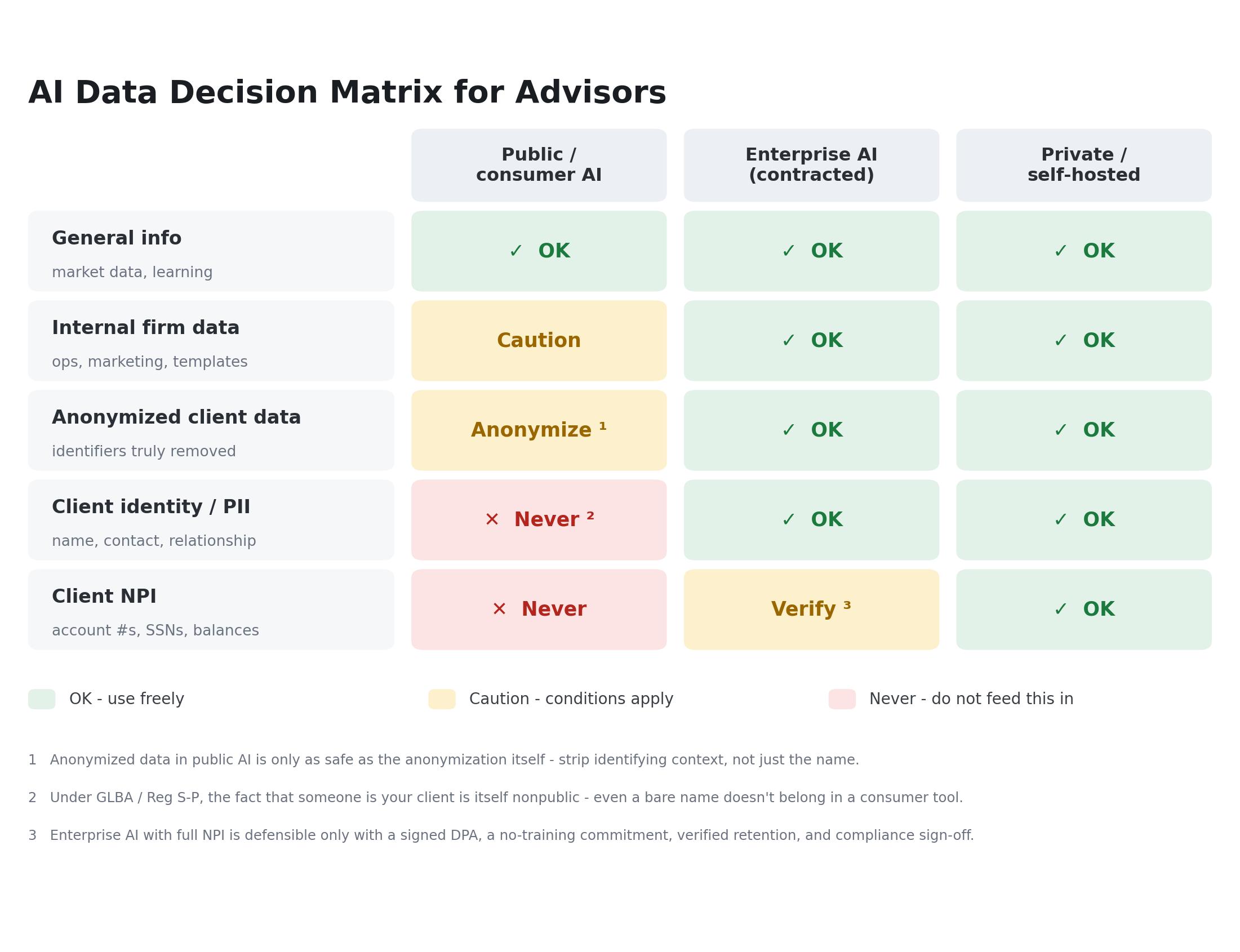
Understand your tools and the underlying technology. Read your contracts and properly configure your systems. Most importantly, use common sense when interacting with AI.
"Never feed any non-anonymized client data into any public/consumer AI model."
It definitely feels like the wild west out there right now — some advisors yelling "YeeHaw!" as they chase down every opportunity to incorporate AI into their firm. Others are hiding behind saloon doors, hoping they don't accidentally end up with a slug in the belly. Whichever side of the spectrum you land on, please understand this: The true gold is not the fancy AI-enabled software, it's your client's data.